
Three times I pleaded with the Lord to take it away from me. But he said to me, “My grace is sufficient for you, for my power is made perfect in weakness.” Therefore I will boast all the more gladly about my weaknesses, so that Christ’s power may rest on me. That is why, for Christ’s sake, I delight in weaknesses, in insults, in hardships, in persecutions, in difficulties. For when I am weak, then I am strong.
2 Corinthians 12:8-10
Scripture Notes
This is such an amazing piece of scripture that when we read 2 Corinthians chapter 12, we can say, “Even the people of biblical times had struggles, tests and trials. But why?” Paul is so amazing to us because he answers this question in verse 7, “So, to keep me from becoming conceited because of surpassing greatness of the revelations, a thorn was given me in the flesh, a messenger of Satan to harass me, to keep me from becoming conceited.”
Like Paul, we often pray for an end to our pain, struggles, and/or trials. Verse 8 says that Paul prayed three times. This doesn’t mean that he just prayed three times and went on. No, this means that he repeatedly prayed for relief. He was very eager for relief. Much like us today, we find a need to be relieved from difficulties. Repetitively praying for relief shows a keenness to be freed from hardship. If it would have been advantageous for God to remove the throne, he would have certainly done so. The problem wasn’t that God didn’t answer the continuous prayers but that Paul didn’t ask in faith. We know this because Paul didn’t receive consolation. Scripture tells us that whatever we ask in faith, we shall receive. Paul prayed and did not receive. Have you prayed and not experienced relief? To pray with humble adoration before God shows our weakness and His sufficiency. All our prayers are answered, without a doubt, even if the answer is a refusal. Our prayers are not a wasted effort even though we feel our request is not satisfied. We need to keep in mind His grace is sufficient, and He knows what is good for us better than we do.
The world tells us that weakness is a negative trait. Being vulnerable is a failure. It shows inferiority, and we are supposed to suppress our emotions. But God tells us to boast in our weaknesses. By doing so, we can find rest in Christ’s power. When we rely on ourselves, we are not embracing our weakness and limitations. By acknowledging our weaknesses, we can humble ourselves and boast in the strength of God.
As we grow in God’s wisdom, we gain the ability to humble ourselves. In a sermon, a Pastor said, “Enjoy a redeemed life while walking in His ways.” To walk in His ways, we walk in wisdom, humility, and righteousness. Walking in wisdom and humility is true security. In so doing, we trust in the safety of Christ with confidence. We also see the richness of walking in wisdom and humility. Wisdom and humility are more valuable than anything the world can offer because they lead us to seek the truth. Finally, living with wisdom and humility leads us to serve and care for others better. We put others before ourselves, become good stewards of what God has given us, and we meet the needs of others as they arise.
Mankind does not naturally possess the ability to live a life of humbleness and wisdom. It is through living a life in the Lord and walking in His ways that we can humble ourselves, boast in the strength of the Lord, and trust Him with all avenues of our lives.
By P.D. Deckard
MEMORY VERse
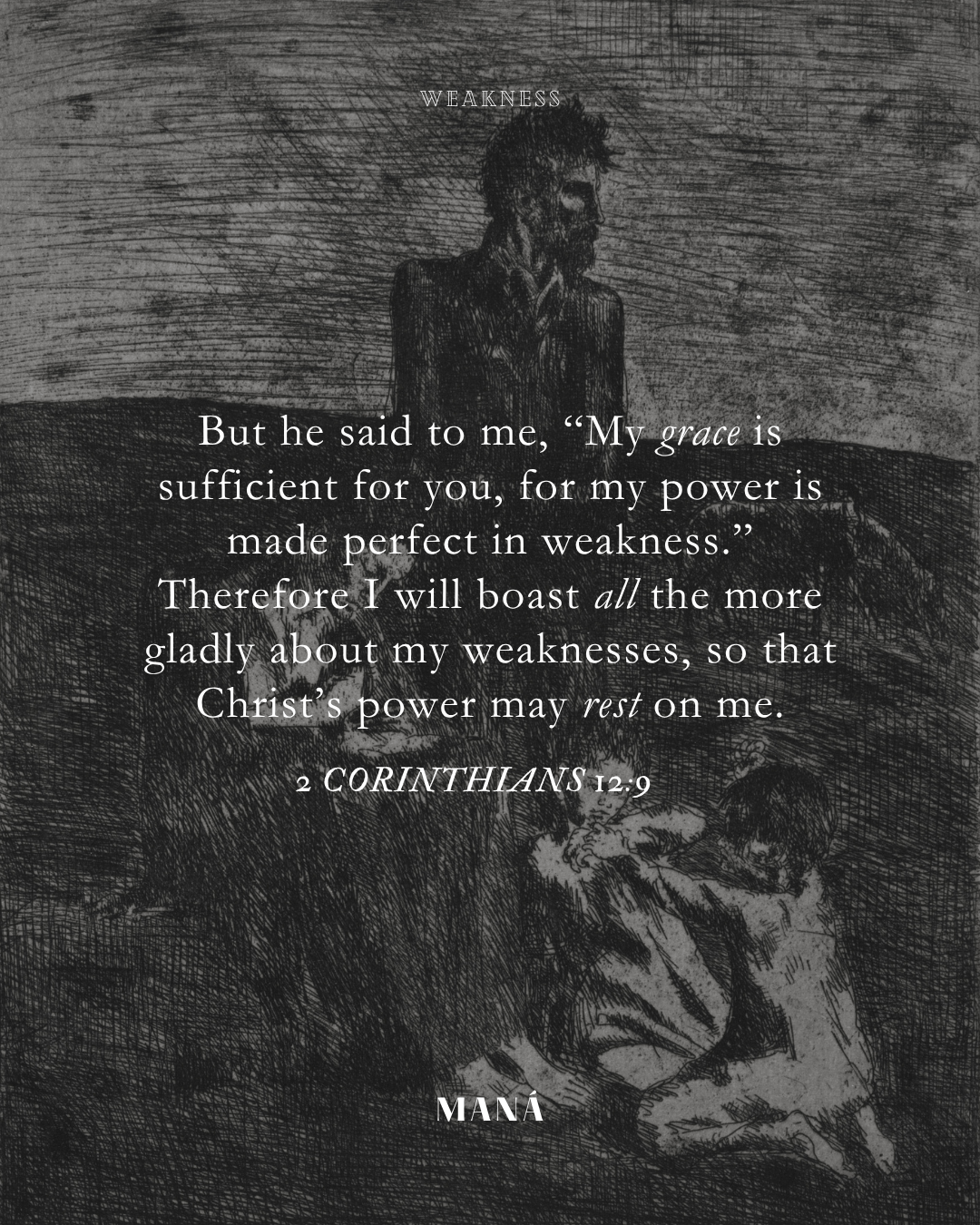
Pablo Picasso. The Saltimbanques: The Poor, 1905, printed 1913. The Cleveland Museum of Art
Related Verses
More verses about embracing weakness for God’s strength:


Prayer Invitation

Application Questions
- What is the persistent weakness in your life that you are praying for God to remove? Is your need for control or strength hindering your prayer from being wholehearted? How can you go from fearing weakness to boasting in your lack of strength?
- What is your initial reaction when you come up against your own weakness and limitations? Do you reach out to the Lord or try to work things out on your own? What change can you make to be sure you react with humility rather than frustration or anger?
- Are you acting like God’s grace is sufficient? What does sufficient grace look like to you, and how can you lean more on the Lord? In what areas of your life do you need to release control and rely more deeply on God?
- Our culture encourages us to project perfection, strength, and self-sufficiency, but how does Paul’s message teach you to rely more on the Lord than on yourself? What changes can you make to be more reliant on the Lord, so that Christ’s power may rest on you?



Leave a Reply