“Ask and it will be given to you; seek and you will find; knock and the door will be opened to you. For everyone who asks receives; the one who seeks finds; and to the one who knocks, the door will be opened.
“Which of you, if your son asks for bread, will give him a stone? Or if he asks for a fish, will give him a snake? If you, then, though you are evil, know how to give good gifts to your children, how much more will your Father in heaven give good gifts to those who ask him! So in everything, do to others what you would have them do to you, for this sums up the Law and the Prophets.
Matthew 7:7-12
Scripture Notes
Culturally, we like the idea that if we ask, something will be given to us. We live by phrases like “the customer is king” or “the client is always right.” However, we are not the customers; God is not the retailer, and faith is not something to be consumed. When we pray and present requests before the Lord, it is not like a vending machine, betting on dice, or being plugged into an algorithm. Prayer is our spiritual soul reconnecting to its maker. To understand what Jesus means when he says, “Ask, seek, and knock,” we need to remove our cultural lenses and look at the word with humility and openness.
To follow Christ and pray consistently is to expect resistance, and we will come up against barriers. If the door were open, then we would not need to knock. We must think of Matthew 7 more like keep asking, keep seeking, and keep knocking. Passion and persistence prove our devotion. If we ask once and then return to our own devices, where is our faith? The reward to those who ask is to find an answer, for seeking to find truth and knocking opens the door to the Lord’s everlasting kingdom.
Just because we ask does not mean we will get exactly what we want. After all, perhaps we don’t know what is good for us. Instead of treating faith like a blank check or meal ticket, we have to remember that we are the ones who have to put faith into practice. Anyone can knock on a door, this is not a process delegated to a special few. We all can reach out to the Lord, but He, in His infinite wisdom, knows how and when it is best to answer.
God is not against us. He is for us and wants to answer our pleas. Even so, we need to be diligent in our prayers and petitions. Not for material comforts or worldly desires, but for ‘good things’ like discernment, spiritual capacity, endurance, and love without inhibition. When we ask for these things, we are told that God will not give us hate when we ask for love, nor will he create confusion when we ask for clarity. We can count on gifts from the Lord being better than what we could have asked for, and yet, when all is said and done, we don’t exhale ourselves. True faith recognizes where glory is due and gives accordingly.
Since the beginning of time, there have been rules to follow and behaviors to avoid. Confucius in the 5th century BC, 500 years before Christ, had a negative golden rule, “Do not do to others what you would not want done to you.” It is fair to believe that other civilizations had a similar philosophy. Jesus turns the negative into the positive. He said in everything, do to others what you would have them do to you. An inactive posture of not causing harm was flipped into an active posture of service and compassion. Jesus declared that it is not enough to simply not injure people, but that we are to actively seek out ways to do good for others.
Culturally, we are trained to be individualistic, self-reliant, ambitious, and to think about oneself. God is calling us to live beyond culture and country. The Golden Rule is not just some nicety or random act of kindness. It is a countercultural mindset that pushes us out of our comfort zone. To follow this act of selflessness would fulfill the Law and the Prophets, the impossible long list of rules set before Israel. No one can meet this demand, which is why we need redemption. That restoration is not something we wait for, but what we should seek instead of things that will rust and fade away. God’s divine assurance is not mere fancy or speculation; it is real. The question is whether we trust and have faith in the Lord or in ourselves.
MEMORY VERse
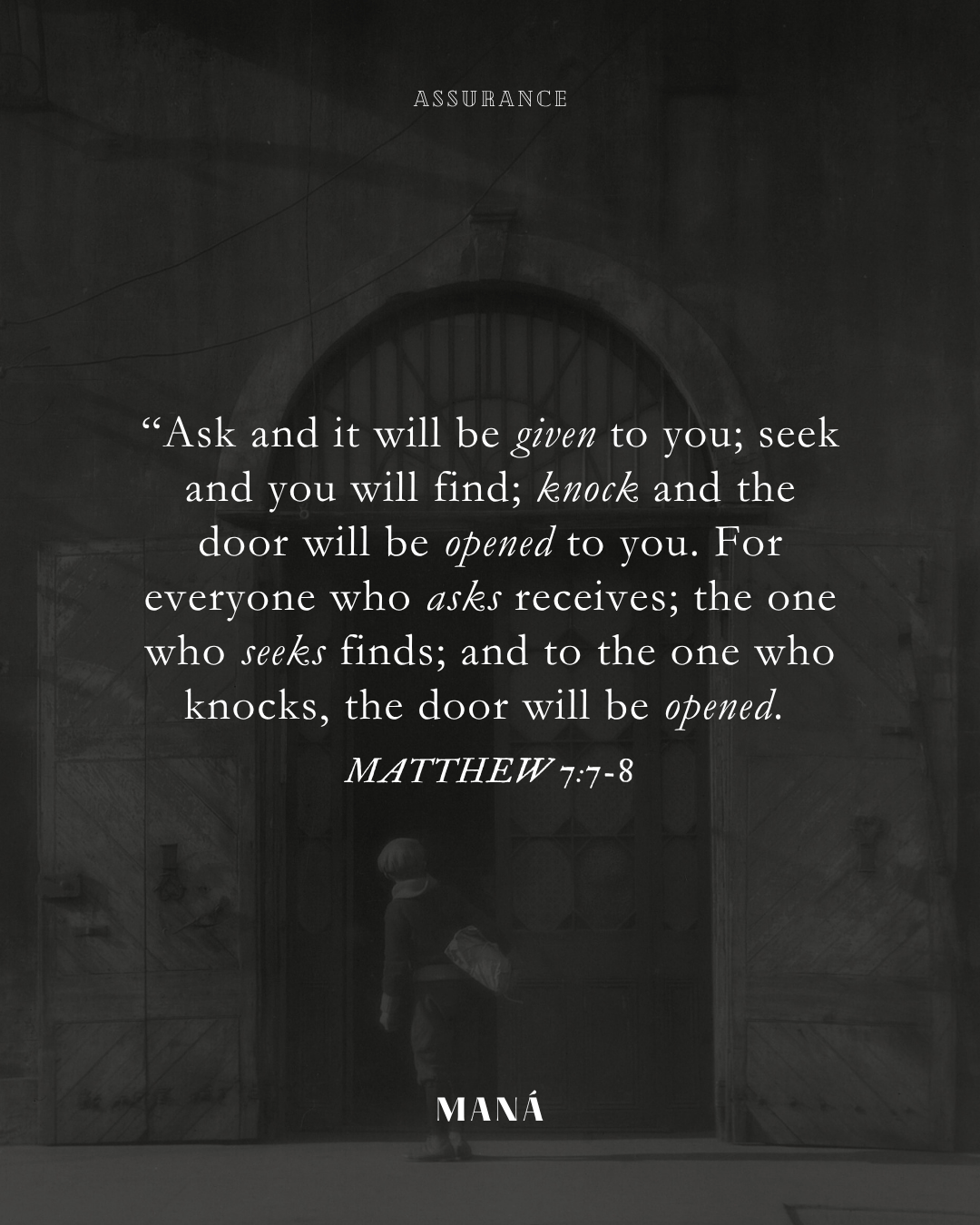
Forman G. Hanna. Untitled [boy looking in open door], 20th century. The Minneapolis Institute of Art
Related Verses
More verses about the assurance in the Lord:


Prayer Invitation
Application Questions
- How are you actively pursuing God? Are you persistent or do you give God a cursory glance now and then? How can you improve your prayer life to be more active in pursuing God?
- Is there something that you used to pray about but don’t anymore? What keeps you from continuing to ask, seek, and knock?
- Do you ignore God’s answers to your prayers, or are you accepting them with grace? How can you stay diligent with your prayer life and be patient for the answer?
- The Golden Rule pushes us to be proactive in showing kindness and generosity. Who comes to mind first as someone you need to treat the way you would want to be treated?
- When someone says or does something hurtful to you, how can you keep an empathetic mindset and remember to be gracious to people who hurt you? What or who can help remind you of the golden rule and keep you from getting discouraged?



Leave a Reply