
Keep reminding God’s people of these things. Warn them before God against quarreling about words; it is of no value, and only ruins those who listen. Do your best to present yourself to God as one approved, a worker who does not need to be ashamed and who correctly handles the word of truth. Avoid godless chatter, because those who indulge in it will become more and more ungodly. Their teaching will spread like gangrene. Among them are Hymenaeus and Philetus, who have departed from the truth. They say that the resurrection has already taken place, and they destroy the faith of some. Nevertheless, God’s solid foundation stands firm, sealed with this inscription: “The Lord knows those who are his,” and, “Everyone who confesses the name of the Lord must turn away from wickedness.”
2 Timothy 2:14-19
Scripture Notes
Salvation can seem to many a one-time event, a moment of acceptance, confession, and repentance. But what we find in the gospel message is not a one-and-done scenario but a daily decision to accept Christ’s lordship over our lives. This is harder than it seems. It means letting go of wants and desires that satisfy the world’s expectations and instead submitting to God’s will and purpose. What has happened is that believers have taken it upon themselves to offer personal opinions, anecdotes, or evaluations of God’s word rather than simply speak the truth. The verbal squabbles we have with other believers are not the purpose for which we are intended. We degrade the truth and injure those who are listening.
Instead of focusing on technicalities, overly precise interpretations, or specific theological definitions, we must remember that Scripture is alive and active (Hebrews 4:12) and speaks to people in different ways. The message is always clear, and the truth unbending, but one person might understand a Scripture one way while another understands its purpose differently. Scripture contains both universal truths and deeply personal understandings, and oversimplifying or unnecessarily complicating God’s word is detrimental to everyone. Otherwise, falsehoods and godless chatter become like cancer, capturing attention and spreading rapidly.
We are to be more focused on working diligently and with attention rather than on petty spats and quarrels. To fulfill our purpose well, we must remember that we will come under inspection at the time of our judgment. To not be ashamed is not to think of our reputation ON earth, but to be able to stand in the presence of the Lord and not be ashamed of the work we DID on earth. Our concern should be that we are approved by God, not the acceptance of others. Our intention should be faithfulness, not the material possessions, power, or influence we can obtain.
Rightly dividing has several ideas associated with the ancient term.
Rightly handle the Word of God, as one would rightly handle a sword.
Plow straight with the Word of God, properly presenting the essential doctrines.
Properly dissect and arrange the Word of God, as a priest would dissect and arrange an animal for sacrifice.
Allot to each their portion, as someone distributing food at a table.
—Enduring Word
To rightly divide means there is also a way to divide wrongly. This happens when someone mishandles the Word, whether by leading with falsehoods or by using the Word as a weapon. Their message is crooked rather than straight, poorly or falsely arranged, and not fully fleshed out with the truth of Scripture. We must ALWAYS test the Spirit (1 John 4:1-6) to ensure that the interpretations we say or hear are correct.
Timothy calls out the idea-babble of two leaders, Hymenaeus and Philetus, who claimed they were already in the millennial kingdom and that our resurrection had already taken place. Hymenaeus was previously mentioned as having been delivered to Satan so he would no longer blaspheme (1 Timothy 1:18-20). Clearly, some leaders were teaching others in ways more aligned with their own beliefs than with the Word. Even if one believer is led astray, we should recognize that ego-centered teachings in Scripture must be shut down.
We can have confidence in God, who has a solid foundation. He knows those who are faithful and those who are corrupting the Word (Romans 8:16-17). It is not our job, nor do we have the ability, to know who truly belongs to Him. We can turn away from idle babbling, quarrels, empty talk, and wickedness. We can hold church leaders accountable and be sure to test the Spirit against what we are being taught. We can also put our energy into diligent workmanship, be unashamed of our purpose, and hold fast to truth.
MEMORY VERse
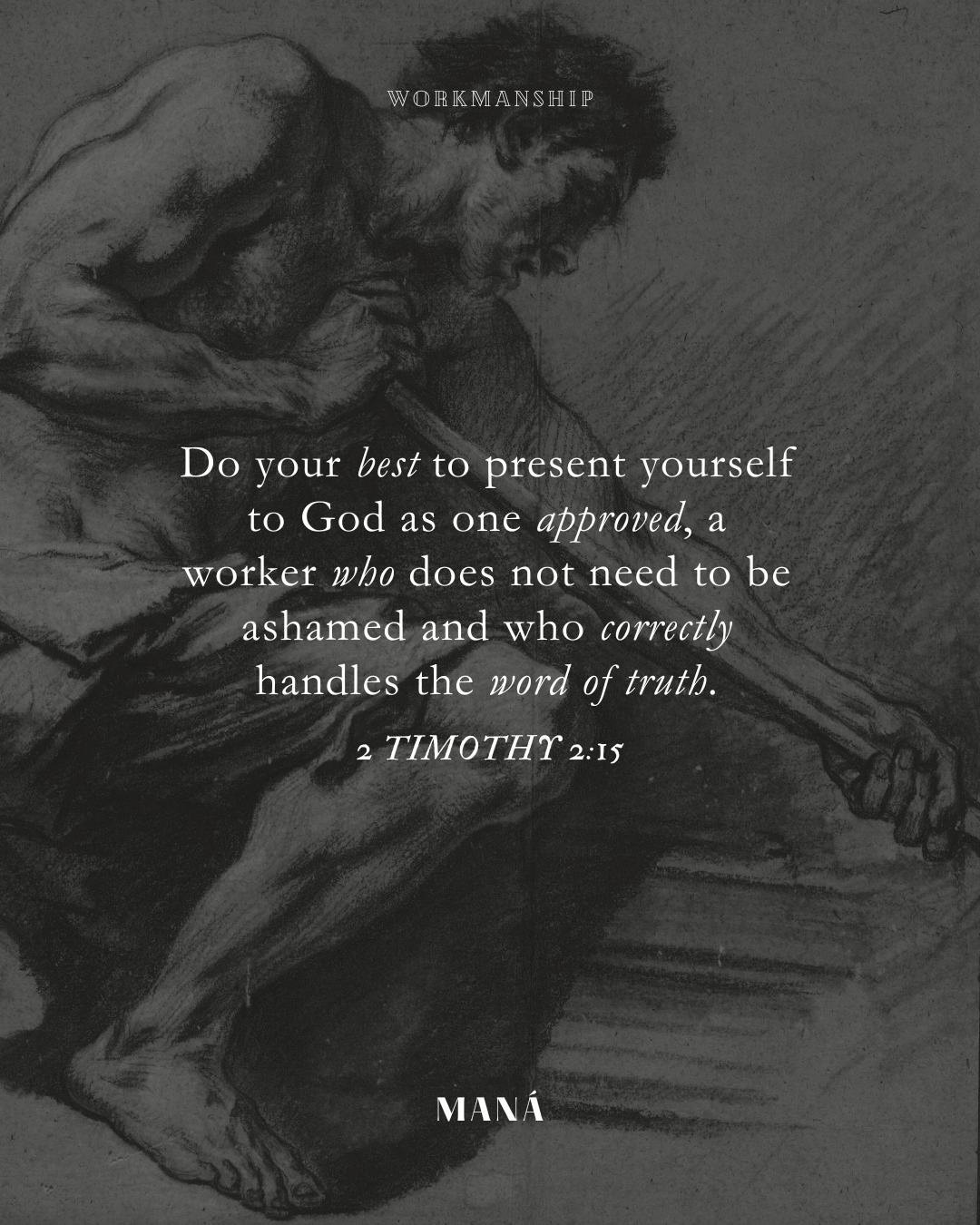
Félix Bracquemond. The Bath, c. 1900, The Cleveland Museum of Art
Related Verses
More verses about diligence and focus:


Prayer Invitation
Application Questions
- Are you able to tell the difference between an essential biblical truth and an empty online or in-person argument that has the potential to harm faith? If not, what practices and measures can you put in place to better understand truth? If you can differentiate, how can you be sure not to get caught up in quarrels about words with others?
- Are there any daily conversations or media habits you need to quit or avoid? How can you steer clear of ungodly discussions and stay more focused on the straight path of truth?
- How does knowing that God is watching you through your life and that you will one day have to defend yourself before His judgment change the way you study the Word, pray, serve, and share the good news?
- How does remembering that God is watching your life change the way you study and share His word?
- Is there a specific habit, tendency, cultural norm, or dishonest approach that you need to turn away from right now to bring you closer to God and show that you belong to Him?




Leave a Reply