
One person gives freely, yet gains even more;
another withholds unduly, but comes to poverty.
A generous person will prosper;
whoever refreshes others will be refreshed.
People curse the one who hoards grain,
but they pray God’s blessing on the one who is willing to sell.
Whoever seeks good finds favor,
but evil comes to one who searches for it.
Those who trust in their riches will fall,
but the righteous will thrive like a green leaf.
Whoever brings ruin on their family will inherit only wind,
and the fool will be servant to the wise.
The fruit of the righteous is a tree of life,
and the one who is wise saves lives.
Proverbs 11:24-30
Scripture Notes
Believers and unbelievers alike often oversimplify scripture or interpret the word of God to fit current national priorities. Living in a country where the economy is a top concern, it’s easy to read Proverbs and assume that generosity directly leads to personal wealth. However, scripture does not promote giving as a consumerist way to gain more. The Bible reveals the paradox of giving: the more we give, the more we receive — not necessarily in monetary terms. We offer our time, kindness, the benefit of the doubt, compassion, hope, and love. Many forms of generosity are impossible to measure or quantify.
Part of the paradox is that when we give cheerfully and willingly, we often do not realize what we have gained from the act. Generosity in God’s name is not transactional. We do not give a sum and then receive that amount plus interest as a reward. Those are human concepts, not divine ones. We are called to “give and let go,” meaning that we give faithfully even if there is no immediate reward. We cannot guarantee a return or even specific results. Our lives should not be attached to earthly wealth but should instead recognize the indeterminate fortune and glory of following Christ, which cannot be measured in worldly terms.
In the devotional The Blessing of Giving, we learned that it isn’t enough just to be generous; we also recognize the importance of not exploiting the system or cheating people out of what they are owed. In a society full of “haves” and “have-nots,” the easy path is to look out for oneself. In fact, our culture celebrates the power of the individual and the “survival of the fittest” mentality. Yet, programs, categories, prejudices, stigmas, and policies consistently prevent people from receiving the benefits they rightfully deserve. Being a believer means not getting caught up in a zero-sum game or focusing solely on a community of believers. We are called to give generously and faithfully, regardless of the merit of the beneficiary.
The paradox of generosity is that it is not a formula, algorithm, or system to follow in order to be wealthy. The very nature of a paradox is that it involves a contradiction. The idea of giving more as one earns more is unfathomable in a culture overwhelmed by financial worries. However, Christ addressed provision in Matthew 6:26-30, instructing us not to worry but to entrust our concerns to Him, because we are loved and cared for. We do not act generously as a deposit toward the future. Instead, we can only give freely with a joyful spirit, letting go of control and power.
Just like the seasons of nature, so too do riches come and go. We are called not to trust in riches just like we learned in the Source of Strength that we should not trust in horses, chariots, the economy, Wall Street, the white house, the law, or our bank account. Like a dying leaf, all those entities rise and fall. Instead, if we trust in God, we will thrive like a green leaf, like an evergreen, never fading.
Instead of an exchange, we should see generosity as a reciprocal opportunity. The saying goes, “hurt people, hurt.” What then could it mean if “generosity breeds generosity?” If we focus more on giving in good faith and worry less about the outcome, we free ourselves from the control we honestly never had and return the honor to the Lord. We share a common commission to give rather than receive, to market honestly, and to trust in the Lord rather than ourselves.
‘What you seek for others, you will get yourself’ – Derek Kidner (Tyndall Old Testament Commentary)
MEMORY VERse
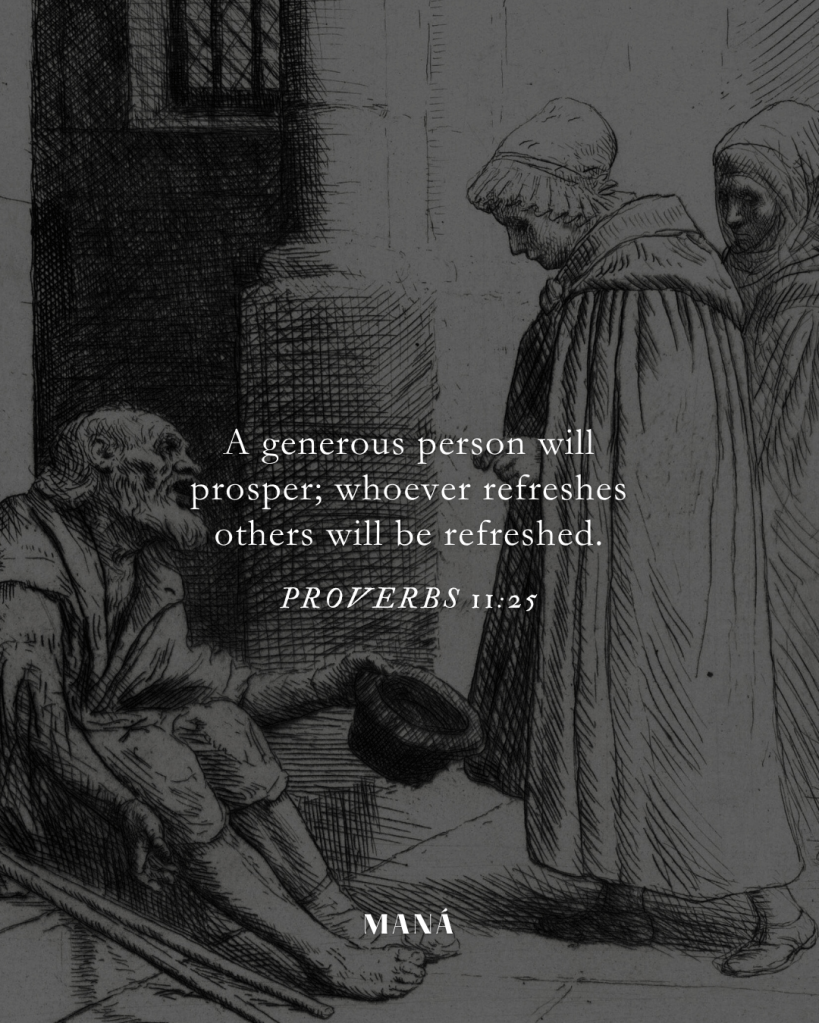
Charity. Alphonse Legros, 1837 – 1911. The Rijksmuseum
Related Verses
More verses about a heart of generosity:


Prayer Invitation
Application Questions
- How can you apply the principle of giving freely, yet gaining even more, to your finances?
- How can you combat the temptation of greed and the urge to hoard more than you need instead of sharing what you have with others?
- How does ‘those who trust in their riches will fall, but the righteous will thrive like a green leaf, challenge’ your perspective on financial security and faithfulness?
- What are some practical ways you can demonstrate your trusting God rather than in money?
- In what ways do you actively seek good in your life? How do you actively search for evil? How do those two actions differ?



 MANÁ
MANÁ 
Leave a comment