
And whatever you do, whether in word or deed, do it all in the name of the Lord Jesus, giving thanks to God the Father through him.
Wives, submit yourselves to your husbands, as is fitting in the Lord.
Husbands, love your wives and do not be harsh with them.
Children, obey your parents in everything, for this pleases the Lord.
Fathers, do not embitter your children, or they will become discouraged.
Slaves, obey your earthly masters in everything; and do it, not only when their eye is on you and to curry their favor, but with sincerity of heart and reverence for the Lord. Whatever you do, work at it with all your heart, as working for the Lord, not for human masters, since you know that you will receive an inheritance from the Lord as a reward. It is the Lord Christ you are serving.
Colossians 3:17-24
Scripture Notes
Paul has just shared in verses 5-9 not to just avoid but put to death:
…sexual immorality, impurity, lust, evil desires, greed, anger, rage, malice, slander, and filthy language. and lies.
And verses 12-14 share positive traits we are to exemplify:
…compassion, kindness, humility, gentleness, and patience, bearing with each other, forgiving one another, and putting on love.
It is clear what actions lead to death and which actions lead to life. There is no “doing the wrong thing for the right reason” argument here. This helps us understand that when we succumb to our sinful nature and those around us do the same, we will have no peace, and death awaits us all. Rich or poor, male or female, regardless of ethnicity, we are equally responsible for the life we have on earth. With that life, we are told that ‘whatever we do, whether in word or deed, do it all in the name of the Lord.” Not for our country, not for our culture, not even for ourselves, but for the Lord. In this act of working for the Lord, we are called to give thanks. Why? Because if it weren’t for Jesus and his sacrifice on the cross, not one of us would have anything to look forward to as we toil away except for the darkness of death.
Once Paul has made it clear what our actions should be and what attitude we should have, he dives into specific roles. Now, we come to the mother of all misinterpretations: the section of wives, husbands, children, and slaves. It may be that separate pages will be needed to write about each of these roles and what is actually being asked of each person, but here, we will focus on the overarching meaning of Colossians 3. No matter who we are or what role we fill, whether it is a position we want or are obligated to fulfill, we are to do the work wholeheartedly for the Lord while giving thanks to God.
What often gets too much of our attention are the abuses surrounding the words “submit,” “obey,” and “work.” Mankind has violated these terms and abused their purpose. Let us look at the wife, the child, and the slave to learn how we are to follow this guidance of working for the Lord and not earthly masters.
A wife is to submit (be supportive, affirming, and respectful) to her husband, not to all men. Submit, but not be subservient. A husband is to love (self-sacrificially) his wife and not be harsh with her. He is not meant to be passive, nor is he to abuse his power. It is fitting to have a relationship between husband and wife where both are willing to be sacrificial, and neither is only looking out for themselves. This was not a verse meant to give social hierarchy to men and women in general.
Children are to obey their parents. This is a call back to the Ten Commandments which are reinstated here as having importance in a household. Children are to obey their parents even as Jesus obeyed his earthly parents, but even Jesus contradicted his parents when he said he needed to be in the temple teaching the word of his Father. Children are also called to follow the commands of the Lord before the demands of a parent. A child does not have to obey cruelty if it goes against God’s Law. Fathers are again given a specific command: do not embitter your children. To embitter means to anger, make resentful, poison, antagonize, vex, frustrate, alienate, disillusion, and discourage. Words that may sound more familiar would be, Fathers, do not poison your children’s minds with cruelty, do not create hostility, do not disown or estrange yourself from your children, and do not create in your children false ideas about who they are and how much they are valued (whether too high or too low). Fathers are to be a present, encouraging force that brings out the best qualities of their children, not their worst.
Slaves, obey your earthly masters in everything, not only when being watched. American slavery meant cruel treatment, broken families, no rights, and no pay. In the bible, slaves were considered more like bondservants: someone who could sell themselves to repay a debt. A bondservant was paid, treated reasonably well, and could leave servitude once the debt was paid. Regardless of whether the term is slave or bondservant, this is the person who is regarded by society as less than someone who is free. Although many might encourage rebellion, Paul is encouraging humble service and obedience. He goes on to say that the work is not ultimately working for a master but doing work for the Lord. Masters are also given a command in Ephesians 6:5-9, they are to treat slaves as if they are serving the Lord and not threaten or harm them, for God holds no favoritism and is Master over who is free and who is not.
Whether wife, husband, child, father, slave, or master, all are called to work as if the task were for the Lord. Whatever is done or whatever is said should be tested against what God has called us to do. We are not to be angry, greedy, speak foul against one another, nor lie and carry a vengeful heart. We are to be kind, compassionate, humble, and patient, quick to forgive another.
Regardless of what happens here on earth, God is the ultimate judge. He weighs the balance of what we do, whether we work heartily or while complaining, and whether we do good or evil in the open or in secret. He sees and knows it all. This is both comforting and frightening. Frightening in the sense that nothing is hidden, but comfort outweighs any misgivings or overexposure. It is comforting to know that no court could ever remotely match the justice of the Lord.
Our act of obedience does not justify any wrongdoing toward us. God has explicitly shared that justice will be served and that there are eternal consequences to our actions. Since God does not show favoritism, we as believers are not to show partiality, favoritism, or discrimination. As believers, we are to contradict the earthly desire to prop ourselves higher than others. We are to act in accordance with Christ’s example and put on our new selves. Focused more on compassion and humility rather than greed, wrath, and wishing or causing harm against others. Whatever our status, we are all seen as the same in the eyes of God. Whatever we do, by word or deed, should be done for His glory.
MEMORY VERse
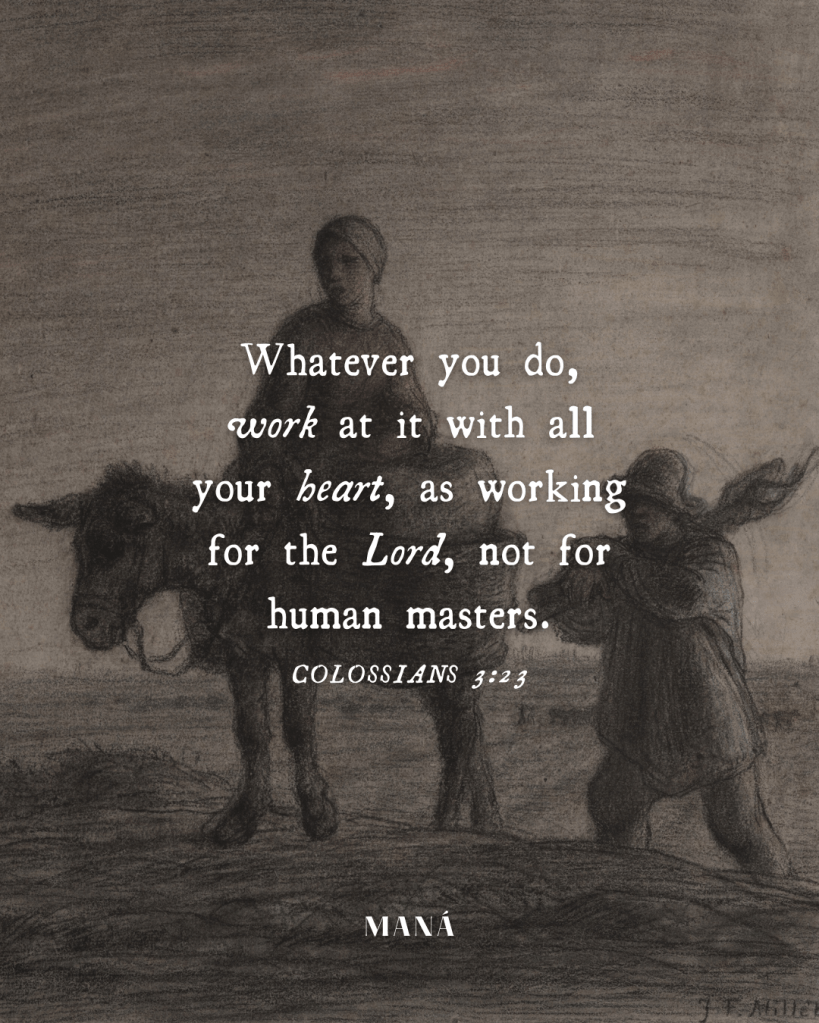
Image: Jean François Millet. The Departure for Work, 1857. The Art Institute of Chicago
Related Verses
More verses about working for the Lord:



Prayer Invitation
Application Questions
How can you better use your words and deeds to serve the Lord?
Are there areas in your life that lack motivation or a strong work ethic? Why? How can you improve?
What is a practical way you can cultivate an attitude of thankfulness?
How can you intentionally practice “working for the Lord with all your heart”?
Cover Image: Jules Breton. The Song of the Lark, 1884. The Art Institute of Chicago




 MANÁ
MANÁ 
Leave a comment