
You, my brothers and sisters, were called to be free. But do not use your freedom to indulge the flesh; rather, serve one another humbly in love. For the entire law is fulfilled in keeping this one command: “Love your neighbor as yourself.” If you bite and devour each other, watch out or you will be destroyed by each other.
So I say, walk by the Spirit, and you will not gratify the desires of the flesh. For the flesh desires what is contrary to the Spirit, and the Spirit what is contrary to the flesh. They are in conflict with each other, so that you are not to do whatever you want. But if you are led by the Spirit, you are not under the law.
The acts of the flesh are obvious: sexual immorality, impurity and debauchery; idolatry and witchcraft; hatred, discord, jealousy, fits of rage, selfish ambition, dissensions, factions and envy; drunkenness, orgies, and the like. I warn you, as I did before, that those who live like this will not inherit the kingdom of God.
But the fruit of the Spirit is love, joy, peace, forbearance, kindness, goodness, faithfulness, gentleness and self-control. Against such things there is no law. Those who belong to Christ Jesus have crucified the flesh with its passions and desires. Since we live by the Spirit, let us keep in step with the Spirit. Let us not become conceited, provoking and envying each other.
Galatians 5:13-26
Notes
To understand Galatians 5:22-23 and recognize why the fruit of the Spirit was listed as the Christlikeness we should be striving for we need to read more of Galatians. Several churches were formed in Galatia after hearing the good news from Paul that salvation is by faith and in Christ alone. When Paul left, new teachers entered the church and caused the message of Christ to be altered to be a form of Judaism and Christianity—belief in Christ and Moses. Those teachers also tried to ruin Paul’s reputation and claimed he was not a real apostle. In our world, those misleading teachers were trying to cancel Paul and rework the message of the gospel to suit their own purposes.
There was no need for the false leaders to pressure the congregation to both follow Christ and fulfill the Law. Pauls supplies the answer in vs 14 by reminding the congregation that they need only to love their neighbor as themselves and they are found holy in God’s eyes. Households have rules, nations have laws but God’s greatest commandments are, “Love the Lord your God with all your heart and with all your soul and with all your mind and with all your strength.’ The second is this: ‘Love your neighbor as yourself.’ There is no commandment greater than these.”
The message we receive from Paul’s letter is that no one, whether they are false teachers, community leaders or influencers can make our salvation be dependent on following their rules or by showing devotion to them. Rule-keeping and law-abiding do not lead to salvation. Salvation comes through grace, a gift that we cannot earn. Even our good works are not a condition of faith, but a fruit of it. We as Christians have died to the law and strive to lead a life of holiness, not by our own attempts but by the power of the Holy Spirit.
When Paul is describing the fruit of the Spirit he is not merely listing off a list of ideal traits. What he is describing is the natural fruit borne of the Spirit by which we, in our human nature, are not disposed to have. We cannot produce the fruit of the Spirit because, as Paul lists beforehand, we are prone to vile sensuality, hatred, discord, selfishness and wrath. Only through salvation, not of works, is there the indwelling of the Holy Spirit. And yet, belief and the indwelling are not enough. We have to choose to follow the Spirit and be guided toward the likeness of Christ which means going against our own nature. The lack of resistance to our actions does not mean God has sanctioned it, in fact, most likely it may be the opposite He has intended.
Three attitudes that we should avoid:
Conceit
The attitude of holding on to false or empty opinions leads too many people to become self-inflated causing them to believe more highly of themselves than they ought to. When living by laws, rules and materialism it is easy for men and women to boast of what they achieve and of what they have. Believers do this to each other, parading or passively casting their eyes down on anyone who has not met their idea of “holiness” or success.
Practice: Humility – Micah 6:8, Zephaniah 2:3, Ephesians 4:1-3, Philippians 2:1-3
Provocation
It is working against a Spirit-filled life to provoke or challenge people to measure up to one’s own private viewpoints. We can have our opinions, but we are not called to the conversion of those opinions. Believers are the carriers of good news. Like water bearers in the desert, our words and deeds should quench the thirst of those around us and not be poison or vinegar.
Practice: Unity – Psalm 133:1-3, 1 Corinthians 12:12-13, Philippians 4:1-3, Colossians 3:13-15
Envy
It is easy to envy, especially in an environment full of materialism and success-seeking. We can envy possessions, success, character traits, skills, talents and networks. All this we do when comparing ourselves to those we judge to have more things or a better life and we begrudge those perceived as superior. Instead, we are called to value others as better than ourselves and not strive for superiority, supremacy or popularity. The self-righteous desire false glory, but true greatness is found in serving and generosity.
Practice: Generosity – Deuteronomy 15:10-11, Psalm 112:4-5, Proverbs 11:24-26, 1 Timothy 6:17-19
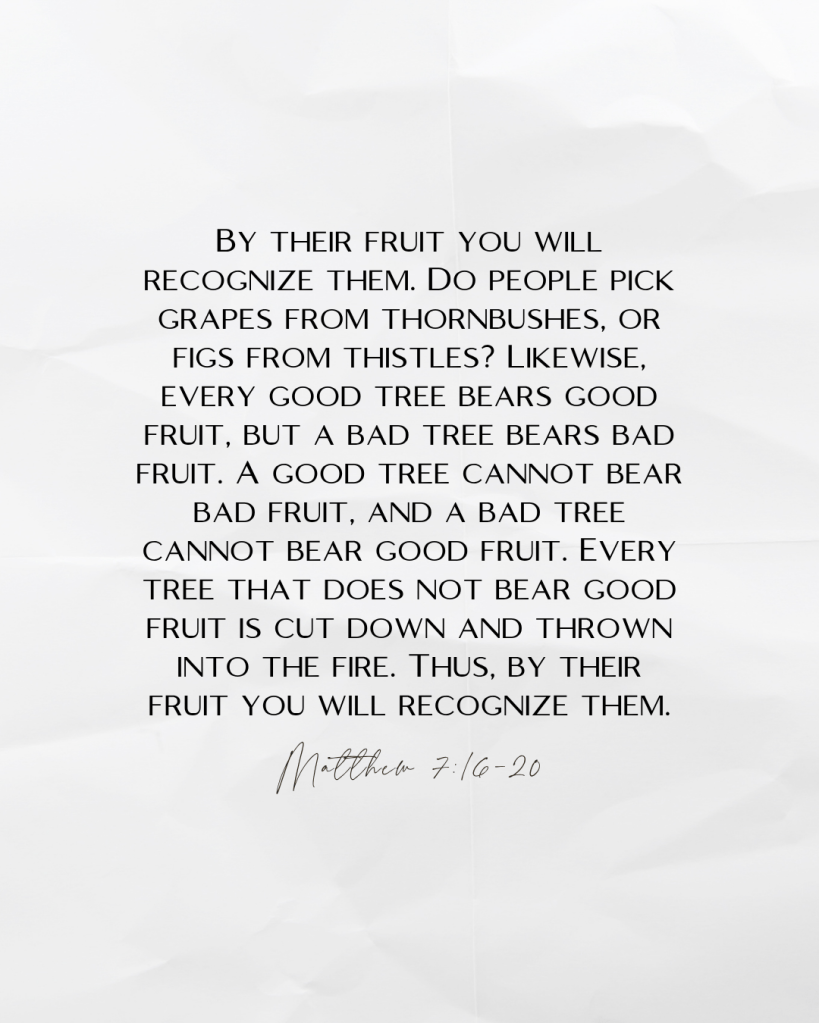
MEMORY VERses

Syndicate Publishing Company. The fruitful mango tree, 1913. The New York Public Library
Related Verses
More verses about christlikeness:


“And perhaps, exhibiting the fruit of the Spirit may be our very best defense against a materialist view of mankind here on earth.“
—Philip Yancey




 MANÁ
MANÁ 
Leave a comment