
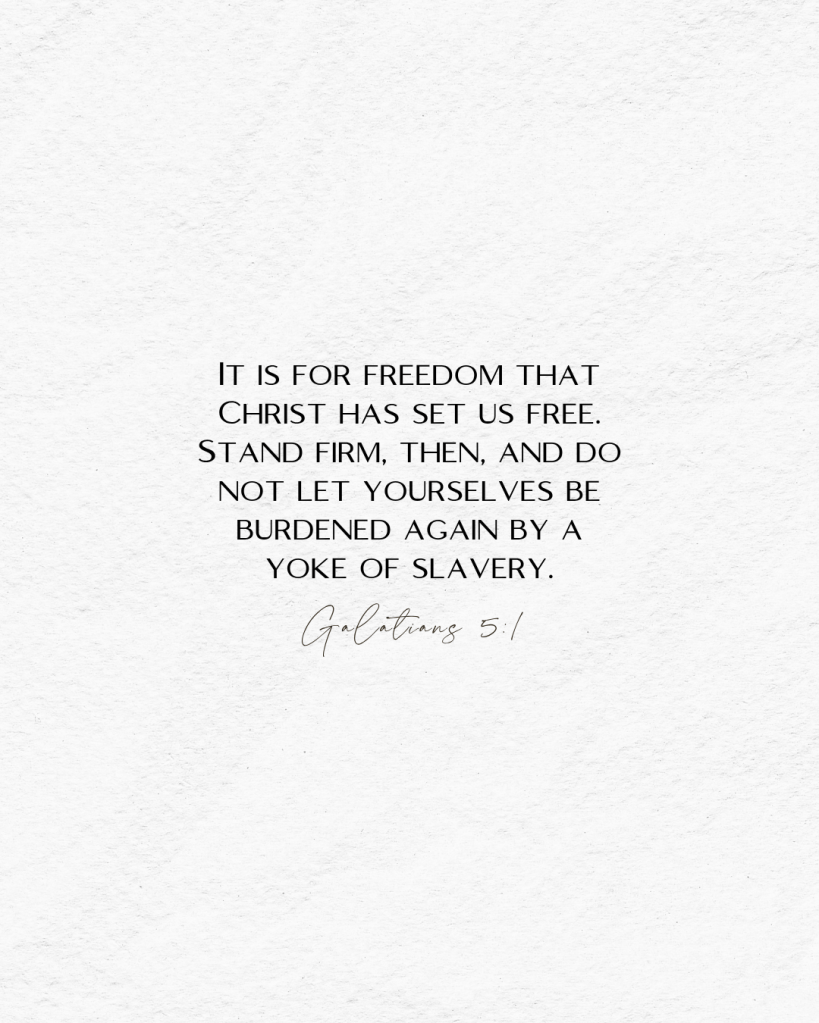
You, my brothers and sisters, were called to be free. But do not use your freedom to indulge the flesh; rather, serve one another humbly in love. For the entire law is fulfilled in keeping this one command: “Love your neighbor as yourself.” If you bite and devour each other, watch out or you will be destroyed by each other.
Galatians 5:13-15
Notes
Words like “freedom” and “rights” are words we are readily familiar with today. We associate these words with our own individual rights rather than thinking of what our freedoms may mean for our neighbors or the people in our community. But we are taught, as believers, to not allow our liberties to be for our indulgence but for the service of others. Individual rights are the lesser liberty compared to communal triumph.
Being called to be free and indulging in freedom are not the same thing. We have been set free from the limitations of the law, but that liberty was not meant to forgo all sense of restriction. Rather than seeking gain for ourselves, we are called to humbly serve others. Our human nature is constantly looking out for the benefit of one’s self. It is only through the grace of God that we are able to look beyond our selfish desires and instead pursue communal benefit.
Do not seek revenge or bear a grudge against anyone among your people, but love your neighbor as yourself. I am the Lord.
Leviticus 19:18
“Love your neighbor” is a command that Jews and Christians were familiar with at the time Galatians was written. In Leviticus God delivered this command to his people and while this was as part of the law, we can take this message of love from God and us it in our present time.
Arguments and division are the “biting and devouring” of another we find in verse 15. Our own selfish predisposition leads to these arguments and the choosing of sides where we claim to be the righteous force against inexhaustible evils. This is where we can find the church in a decisive position in choosing to stand against human nature and fulfill the law through love. Suppose we seek to destroy people, whether they are literally or figuratively our neighbors. In that case, we break away from the path toward true liberation and find ourselves on the pathway to destruction.
Let no debt remain outstanding, except the continuing debt to love one another, for whoever loves others has fulfilled the law. The commandments, “You shall not commit adultery,” “You shall not murder,” “You shall not steal,” “You shall not covet,” and whatever other command there may be, are summed up in this one command: “Love your neighbor as yourself.” Love does no harm to a neighbor. Therefore love is the fulfillment of the law.
Romans 13:8-10
Finally, Romans makes it clear that this command to “Love your neighbor as yourself” encompasses most other commands God gave to his people. When we show love we avoid causing harm to others, even if we have to defer some of our freedom for their sake. Even when it doesn’t make sense or we would rather succumb to our self-inclination, we must put others above ourselves. We can measure how well we are serving God based on how well we love others.
MEMORY VERses

Circle of Henry Fuseli. One Cycle of Hell, 1750/1850. The Art Institute of Chicago
Related Verses
More verses about serving others:


PRAYER INVITATION

“I have found that among its other benefits, giving liberates the soul of the giver.“
—Maya Angelou




 MANÁ
MANÁ 
Leave a comment